
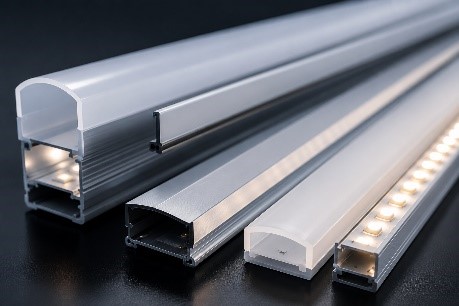
In modern lighting systems, producing sufficient light is not the only consideration; how that light is distributed also plays a critical role in overall lighting quality. When LEDs are used without proper control, they can cause glare, uncomfortable bright spots (Hot Spots), and reduced visual comfort. This is where a diffuser, one of the most important components of a lighting system, comes into play, improving the quality of light to a higher level.
What Is a Diffuser?
A diffuser is a transparent or translucent component placed over a light source. It controls the way light passes through and distributes it evenly throughout the surrounding environment.
The main functions of a diffuser include:
- Reducing glare
- Eliminating bright spots (Hot Spots)
- Creating uniform illumination
- Improving visual comfort
- Enhancing the appearance of the lighting fixture
For this reason, the quality of the diffuser has a direct impact on the final performance of the lighting system.
Light Engineering in the Extrusion Process
Producing a high-quality diffuser is not limited to its appearance or physical shape. The most important factors are the formulation of the raw materials and the precision of the extrusion process.
At Faradid Polymer, diffusers are manufactured using engineered polymer materials and Light Diffusing Additives. These additives allow light to scatter in a controlled manner as it passes through the diffuser, resulting in more uniform light output from the fixture.
The main objective is to achieve a balance between two important properties:
- Light Transmission to maintain maximum brightness and minimize light loss
- Light Diffusion to reduce glare and eliminate Hot Spots
Achieving the right balance requires technical knowledge, extrusion experience, and careful selection of raw materials.
Key Features of a Standard Light Diffuser
A high-quality diffuser should not only perform well when it is first installed, but should also maintain its properties and performance over many years.
Important characteristics include:
- High light transmission with minimal luminous flux loss
- Uniform light diffusion without creating Hot Spots
- Resistance to UV radiation
- Resistance to heat generated by LEDs
- Resistance to yellowing over time
- Dimensional stability and precise installation inside the profile
The quality of the raw materials and the precision of the manufacturing process play a key role in achieving these properties.
Applications of Extruded Light Diffusers
Extruded diffusers are used across a wide range of lighting applications and industries, including:
- Linear Lighting
- Commercial and office lighting
- Architectural lighting
- Retail and shop lighting
- Decorative lighting
- Smart lighting systems
- Industrial lighting equipment
Each application requires a diffuser with specific optical properties, depending on the desired lighting performance and application requirements.
Faradid Polymer’s Approach
At Faradid Polymer, producing a diffuser is not simply about manufacturing a plastic profile. It is an engineered process focused on controlling the behavior of light.
By combining extrusion expertise, careful selection of raw materials, and quality control throughout every stage of production, we strive to provide products that offer not only high visual quality but also stable and reliable optical performance.
Our goal is to develop solutions that meet the requirements of today’s lighting industry while also supporting the needs of future lighting applications.
Conclusion
The quality of a lighting system does not depend solely on its light source; the diffuser determines how that light is perceived. A high-quality diffuser can create more uniform illumination, provide a more comfortable visual environment, and give the final product a more professional appearance.
For this reason, selecting the right diffuser is one of the most important factors in the design and manufacturing of modern lighting systems.
No comments yet.