


What Is an Extrusion Machine?
An Extrusion Machine, also known as an Extruder, is one of the most important and widely used pieces of equipment in the polymer processing and plastic product manufacturing industries. This machine uses a combination of heat, pressure, and mechanical force to melt and homogenize polymer raw materials (granules or powder), and then forces them through a Die with a specific shape to produce products with a continuous and consistent cross-section.
In simple terms, an extrusion machine works somewhat like an industrial meat grinder; however, instead of meat, it melts polymer granules and pushes them through a die with the desired shape to produce a final product with the required cross-section. This process is performed continuously, making it possible to manufacture products with virtually unlimited lengths.
History and Evolution of Extrusion Machines
The history of extrusion dates back to the early 19th century, when this technology was used to manufacture lead pipes. The first extrusion patent was registered in 1820 by Thomas Hancock in England for the production of lead pipes. In the 1930s, with the development of synthetic polymers such as PVC and polyethylene, extrusion rapidly entered the plastics industry. From the 1950s onward, advancements in technology and the development of advanced screw designs transformed extrusion machines into some of the most important manufacturing equipment across various industries.
Today, extrusion machines equipped with advanced digital controls, automation systems, and precision sensors are capable of producing products with high quality, tight tolerances, and very high production speeds.
Main Components of an Extrusion Machine
A standard extrusion machine consists of several main components, each of which plays a critical role in the manufacturing process:
1. Feed Hopper
The feed hopper is where polymer granules or powder, along with the required masterbatches and additives, are introduced into the machine. This component is typically designed in a conical shape so that the materials can easily move toward the screw by gravity. Some hoppers are equipped with drying systems and forced-feed mechanisms to control material flow.
2. Barrel
The barrel is a cylindrical chamber in which the screw rotates. The inner surface of the barrel is typically smooth and hardened to reduce friction with the molten material and prevent wear. The barrel contains heating elements and cooling systems that regulate the process temperature within the desired range.
3. Screw
The screw is the heart of the extrusion machine. This component is designed in a helical shape and, as it rotates, transports the polymer material from the hopper toward the die. The screw is divided into three main sections:
- Feed Zone: Receives the solid material from the hopper and moves it forward.
- Compression Zone: Compresses the material by reducing its volume and assists in the melting process.
- Metering Zone: Delivers the molten material toward the die uniformly and at a constant pressure.
Screw design—including the length-to-diameter ratio, helix angle, and flight depth—has a direct impact on melt quality, production speed, and energy consumption.
4. Heating Elements and Cooling System
Polymer melting requires heat. Heating elements are installed around the barrel and raise the temperature to approximately 200–300°C, depending on the type of polymer. Cooling systems, using air or water, also prevent overheating and polymer degradation.
5. Die
The die is an engineered component that determines the final shape of the product. The polymer melt passes through the die under pressure and takes on the desired cross-sectional shape. Die design is one of the most sensitive and specialized stages of the extrusion process and has a direct impact on the quality, dimensions, and appearance of the final product.
6. Cooling System
After exiting the die, the hot product must be cooled so that it can maintain its shape and dimensions. Cooling is typically performed by passing the product through water cooling tanks or using compressed-air systems. Precise control of cooling speed and temperature prevents deformation and internal stresses in the product.
7. Haul-Off & Cutter
After cooling, the product is pulled forward at a controlled speed by the Haul-Off unit. By adjusting the pulling speed, this unit controls the thickness and dimensions of the product. Finally, the product is cut into the desired lengths and prepared for packaging.
How Does an Extrusion Machine Work?
The extrusion process consists of the following stages:
Stage 1: Feeding the Raw Materials
Polymer granules, along with color masterbatches, UV stabilizers, light diffusers, and other required additives, are fed into the barrel through the hopper.
Stage 2: Melting and Mixing
As the screw rotates, it moves the material forward. At the same time, the heating elements increase the temperature and melt the polymer. The screw design ensures uniform mixing of the materials and additives, creating a homogeneous, bubble-free melt.
Stage 3: Passing Through the Die
The polymer melt passes through the die under high pressure, generated by the screw, and takes on the final shape of the product. Precise control of pressure and temperature at this stage has a direct impact on the surface quality and dimensions of the product.
Stage 4: Cooling and Stabilization
The hot product exits the die and immediately enters the cooling system. Rapid and uniform cooling prevents deformation and internal stresses, stabilizing the product at its precise dimensions.
Stage 5: Pulling and Cutting
After cooling, the product is moved by the haul-off unit at a controlled speed. The pulling speed determines the final thickness of the product. Finally, the product is cut into the required lengths and prepared for packaging.
Types of Extrusion Machines
Extrusion machines can be classified into different categories based on the number of screws, application, and raw materials:
1. Single-Screw Extruder
- Structure: Equipped with one helical screw
- Advantages: Simple design, affordable cost, easy maintenance and repair
- Applications: Manufacturing simple profiles, pipes, thin films, and diffusers
- Suitable for: Free-flowing polymers such as PVC, PE, PP, and PS
2. Twin-Screw Extruder
- Structure: Equipped with two parallel or conical screws
- Advantages: Better mixing and homogenization, capable of processing powdered materials and higher levels of additives
- Applications: Manufacturing compounds, masterbatch blends, engineering materials, and sensitive polymers
- Suitable for: Complex formulations and high-viscosity materials
3. Multi-Screw Extruder
- Structure: Equipped with three or four screws
- Advantages: Provides the highest level of mixing and homogenization
- Applications: Highly specialized and specific applications
Applications of Extrusion Machines in Different Industries
Extrusion machines have a wide range of applications across various industries:
| Industry | Manufactured Products |
|---|---|
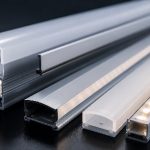
| Lighting Industry | LED diffusers, polycarbonate covers, lighting profiles, shelf labels |
| Construction Industry | Door and window profiles, PVC pipes, sealing strips, decorative trims |
| Automotive Industry | Interior fittings, decorative trims, engineered components, hydraulic tubes |
| Packaging Industry | Thin films, nylon, plastic bags, polymer sheets |
| Medical Industry | Medical tubes, catheters, disposable equipment |
| Electrical & Electronics Industry | Cable sheathing, electrical insulation, cable management channels |
| Agricultural Industry | Drip irrigation pipes, greenhouse decorative strips |
| Furniture Industry | Decorative trims, edge profiles, polymer components |
Advantages of Using an Extrusion Machine
| Advantage | Description |
|---|---|
| Continuous & Mass Production | Ability to manufacture products with virtually unlimited lengths and high production volumes |
| Consistent Quality | Precise parameter control and consistent product quality |
| High Flexibility | Ability to manufacture various products by changing the die |
| Reduced Waste | A process with minimal waste and the possibility of recycling |
| Cost-Effective | Low production cost per unit |
| High Production Speed | Ability to manufacture products at very high speeds |
Faradid Polymer; Expertise in Extrusion and Beyond
Faradid Polymer is considered one of the leading companies in the field of designing, engineering, and manufacturing polymer products using extrusion technology, building on the extensive specialized experience of its founders in the polymer and extrusion industry. By utilizing advanced single-screw and twin-screw extrusion machines, an experienced engineering team, and strict quality control, the company manufactures products with outstanding quality and high dimensional accuracy.
Faradid Polymer’s Extrusion Capabilities:
| Area of Expertise | Description |
|---|---|
| Extrusion Die Design & Manufacturing | Design and manufacturing of customized dies for producing complex profiles |
| Polymer Profile Manufacturing | Production of various polycarbonate, acrylic, PVC, and other polymer profiles |
| Lighting Diffuser Manufacturing | PC and PMMA diffusers with light transmission of up to 94% |
| Fittings & Engineering Components Manufacturing | Shelf labels, shelf label holders, and polymer trims |
| Material Formulation Development | Optimization of formulations for mechanical, optical, and thermal properties |
| Custom Product Manufacturing | Designing and manufacturing products based on customer drawings and samples |
Why Choose Faradid Polymer?
- Technical Expertise & Industrial Experience: Years of experience in the polymer and extrusion industry
- Advanced Machinery: Use of modern extruders with digital controls
- Strict Quality Control: Monitoring every stage, from raw materials to the final product
- Premium Raw Materials: Use of high-quality European and Asian polymer grades
- Custom Manufacturing Capability: Manufacturing products according to the customer’s exact requirements
- Quality Assurance: Confidence in product durability and performance
Final Summary
The extrusion machine is the heart of the polymer industry and one of the most important manufacturing technologies in the modern world. Through a continuous, precise, and efficient process, this machine enables the production of a wide range of polymer products, from lighting diffusers and building profiles to automotive fittings and retail shelf labels.
Faradid Polymer, relying on engineering expertise, industrial experience, and a commitment to quality, is one of the reputable manufacturers of extruded products in Iran. If you are looking for a professional and reliable partner for the design, manufacturing, and supply of polymer products, the Faradid Polymer team is ready to support you throughout every stage—from technical consultation and die design to production and delivery—and provide the best solutions tailored to your project’s requirements.
No comments yet.