
What Is a Fluorescent Light Diffuser Cover and What Role Does It Play in Lighting Systems?
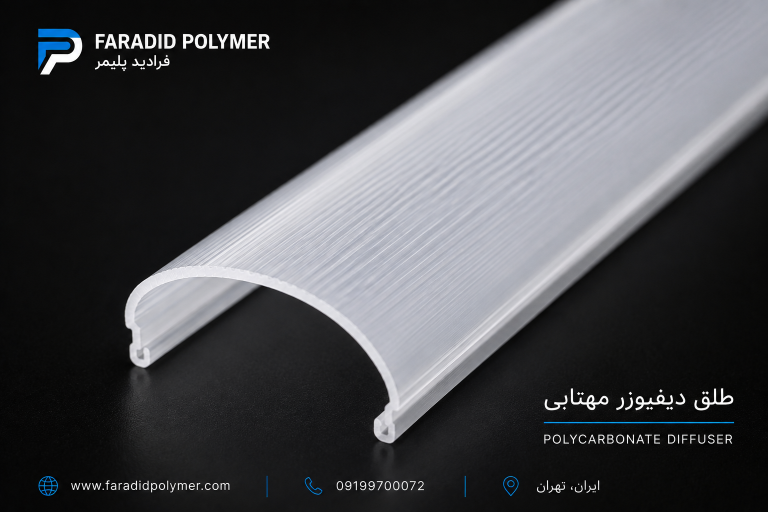
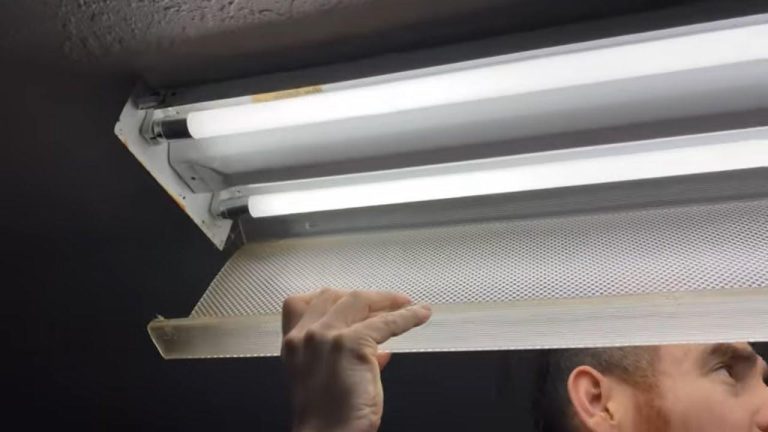
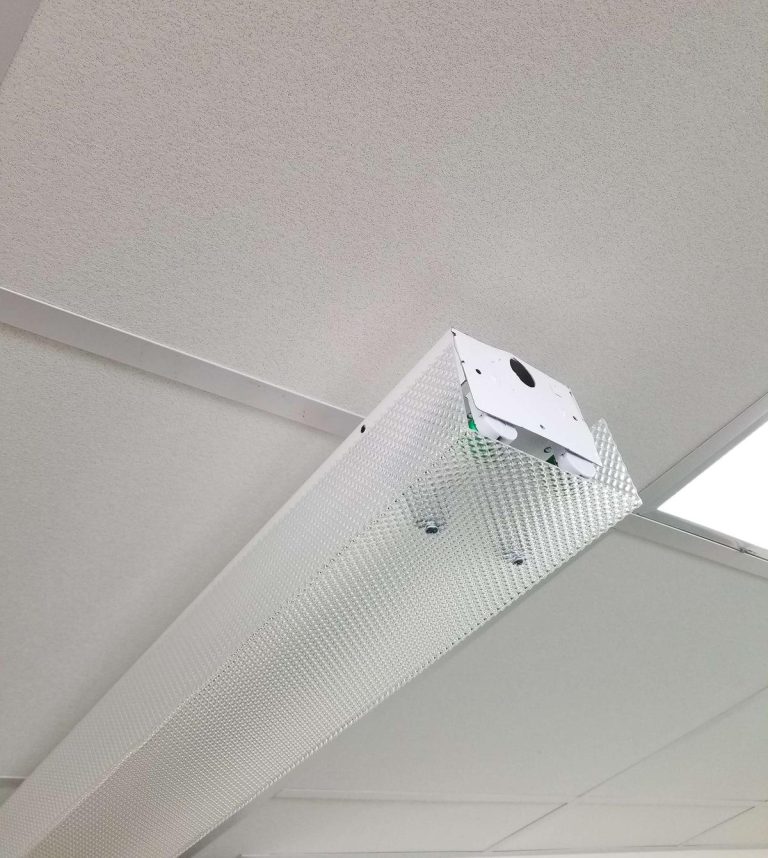
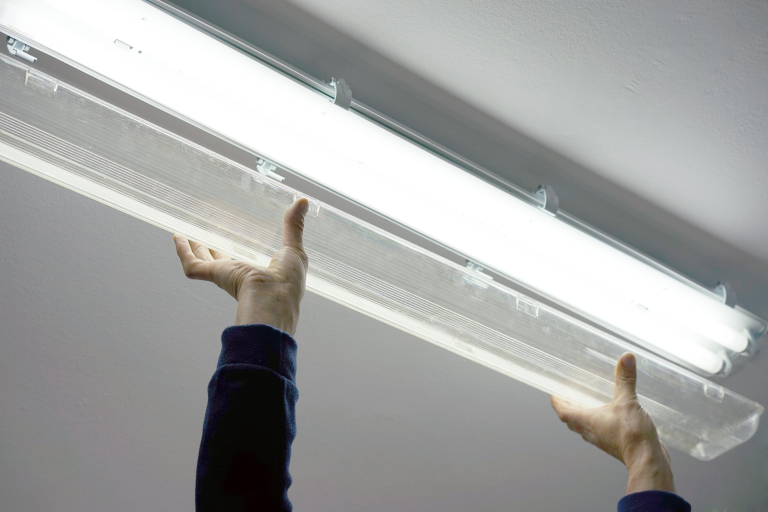
A fluorescent light diffuser cover, also known as a Light Diffuser Panel or Diffuser Cover, is one of the most essential components of modern fluorescent and LED lighting systems.
Usually manufactured from polycarbonate (PC) or acrylic (PMMA), this component is installed as a cover over lamps or linear light fixtures. Its primary function is to distribute light generated by point or linear light sources in a uniform, soft, and glare-free manner throughout the environment.
In simple terms, a fluorescent light diffuser acts as a light engineer. Without a diffuser, fluorescent or LED light can be emitted directly at high intensity, which may cause visual discomfort, create bright hot spots, and significantly reduce the overall quality of illumination.
Through light diffusion and refraction, the diffuser spreads the light over a larger surface area with a more balanced intensity, creating a more comfortable visual experience.
Why Is a Fluorescent Light Diffuser Important?
The importance of a fluorescent light diffuser goes far beyond simply acting as a cover. It has a direct impact on lighting quality, visual comfort, the appearance of the environment, and even energy consumption.
1. Glare and Hot Spot Reduction
Fluorescent lamps and LEDs can create uncomfortable glare and bright spots when used without a diffuser. These effects may contribute to eye fatigue, headaches, and reduced concentration.
A diffuser distributes the light more evenly across the entire surface, reducing its intensity and creating a more uniform illumination.
This feature is particularly important in workplaces, educational facilities, and public spaces where people are exposed to artificial lighting for extended periods.
2. Improved Visual Comfort and Eye Health
Uniform, glare-free illumination significantly improves visual comfort.
Standard diffusers can help reduce visual fatigue in working environments and contribute to a more comfortable lighting environment. This is particularly important in locations such as healthcare facilities, schools, and libraries, where visual accuracy and comfort are important.
3. Improved Appearance of the Light Fixture and Environment
Fluorescent light diffuser covers are available with smooth, glossy, or matte surfaces, giving lighting fixtures a modern, elegant, and professional appearance.
High-quality diffusers should be free from surface defects, scratches, and impurities and can also serve as a decorative element in interior design.
In premium environments such as hotels, restaurants, and branded retail stores, diffuser quality can directly influence the customer’s perception of the space and brand.
4. Protection of Lamps and Internal Components
In addition to controlling light, a diffuser also acts as a protective layer.
It helps protect lamps, LED boards, drivers, and electrical connections from dust, moisture, insects, impact, and environmental factors.
This is especially important in industrial environments, warehouses, parking areas, and outdoor spaces, where lighting fixtures may be exposed to damaging conditions.
5. Extended Lighting Fixture Service Life
By protecting internal components and helping prevent the penetration of dust and moisture, a diffuser can contribute to a longer service life for lighting fixtures.
In LED lighting systems, a properly designed diffuser can also contribute to thermal management and help prevent excessive heat buildup around LED boards.
Types of Fluorescent Light Diffuser Covers by Material
The choice of diffuser material directly affects light quality, durability, cost, and application.
The two primary materials used for fluorescent light diffusers are polycarbonate (PC) and acrylic (PMMA).
Understanding the differences between these materials is an important step in selecting the right diffuser.
Polycarbonate (PC) Light Diffuser Cover
Polycarbonate (PC) is one of the most impact-resistant engineering polymers and is an ideal choice for environments where durability, safety, and resistance are priorities.
| Feature | Description |
|---|---|
| Impact Resistance | Very high; approximately 250 times that of glass and 30 times that of acrylic. It does not shatter easily upon impact and provides a high level of safety. |
| Thermal Resistance | Excellent; withstands temperatures up to approximately 120°C without significant deformation. |
| UV Resistance | Can be enhanced with UV-resistant additives; suitable for outdoor and high-light environments. |
| Self-Extinguishing | Available in UL94 V-0 to V-2 grades; resistant to fire and flame propagation. |
| Light Transmission | 85–92%, depending on surface type and thickness. |
| Weight | Lightweight, approximately half the weight of glass, making transportation and installation easier. |
| Price | Higher than acrylic, but cost-effective considering its durability and service life. |
Main Applications: Industrial environments, warehouses, workshops, parking areas, high-traffic public spaces, durable linear lights, outdoor lighting, and transportation equipment.
Acrylic (PMMA) Light Diffuser Cover
Acrylic (PMMA), also known as Plexiglass, is recognized for its excellent optical clarity and light quality and is an ideal choice for environments where visual appearance and maximum light transmission are important.
| Feature | Description |
| Transparency | Very high; up to 94% light transmission with clarity close to glass. |
| Impact Resistance | Moderate; higher than glass but lower than polycarbonate. |
| Thermal Resistance | Up to approximately 80°C. |
| UV Resistance | Good; with appropriate stabilizers, it can resist yellowing. |
| Weight | Lightweight, approximately half the weight of glass. |
| Price | More economical than polycarbonate. |
Main Applications: Premium lighting, architectural lighting, retail displays, decorative lighting, modern office environments, hotels, restaurants, and illuminated signs.
Types of Light Diffuser Covers by Surface and Appearance
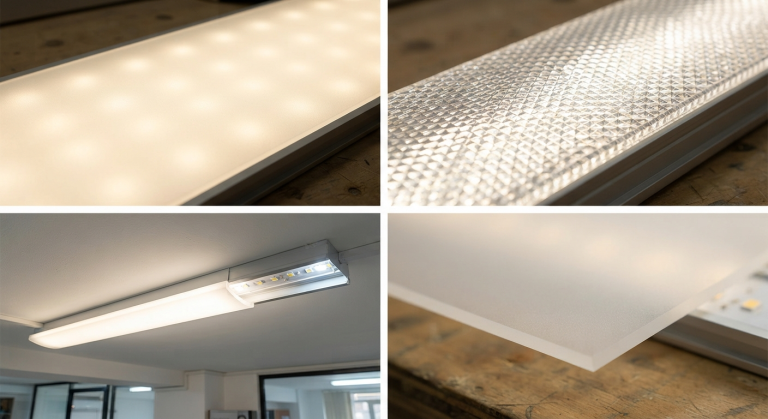
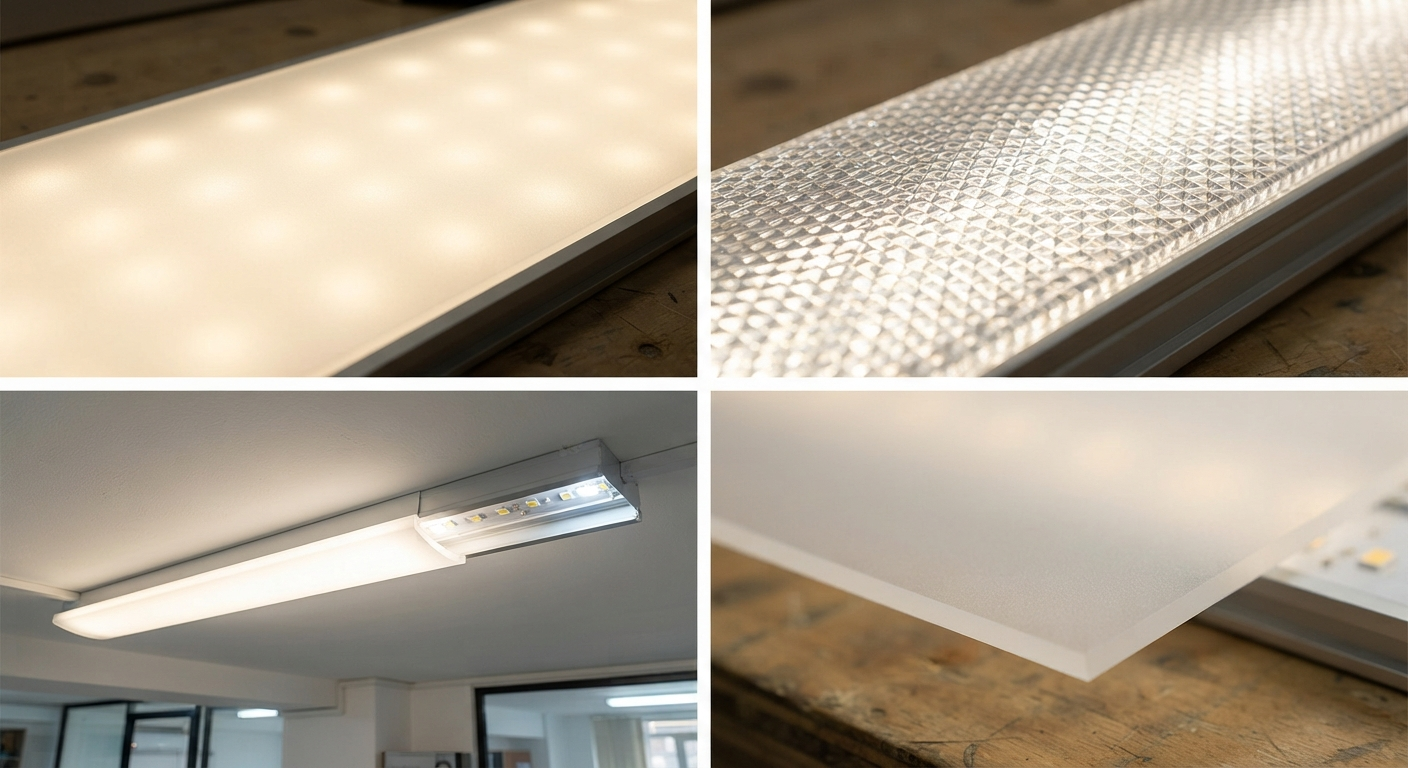
Fluorescent light diffuser covers are manufactured with different surface finishes to meet various lighting and design requirements.
1. Clear Diffuser
- High light transmission: More than 90%
- Suitable for: Applications where maximum brightness is important, such as industrial lighting, warehouses, and large spaces.
- Key feature: Minimum light loss and maximum lighting efficiency.
2. Opal / Milky Diffuser
- Uniform light diffusion and glare reduction: An excellent option for working and office environments.
- Suitable for: Offices, retail stores, schools, and hospitals.
- Key feature: Produces soft, comfortable, and glare-reduced illumination.
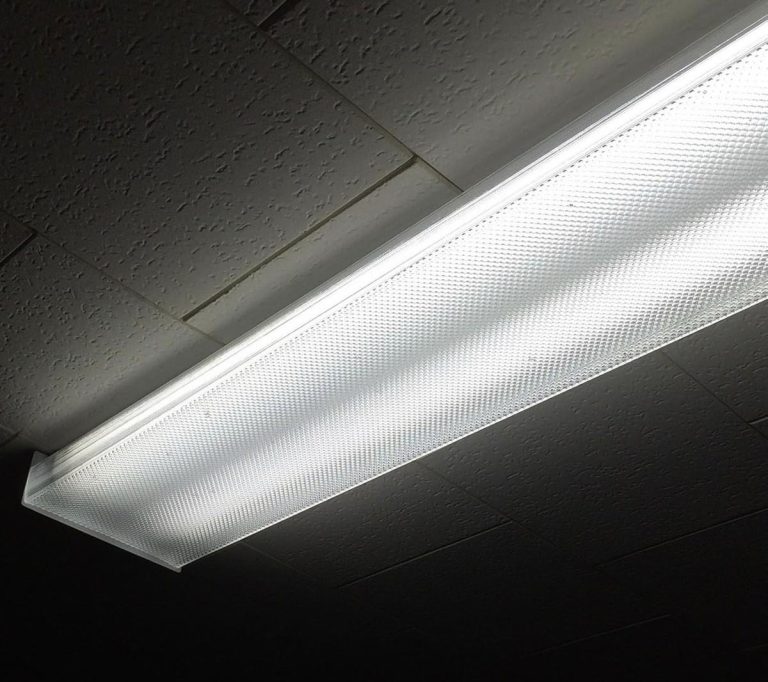
3. Prismatic / Textured Diffuser
- Precise light control and optimized distribution: Uses prismatic structures on the surface.
- Suitable for: Applications requiring light-angle control and maximum light distribution.
- Key feature: Effective glare reduction and excellent light distribution.
4. Micro-Prismatic Diffuser
- Reduced Glare Rating (UGR): Designed to reduce glare to below 19.
- Suitable for: Visually sensitive environments such as conference rooms, control rooms, and precision workspaces.
- Key feature: High-level glare control and excellent lighting quality.
Advantages of Polycarbonate (PC) Fluorescent Light Diffuser Covers
Polycarbonate is considered one of the best materials for fluorescent light diffuser covers because of its unique combination of strength, safety, and optical performance.
1. Exceptional Impact and Break Resistance
Polycarbonate offers approximately 250 times the impact resistance of glass and 30 times that of acrylic.
This property is particularly valuable in industrial environments, warehouses, parking areas, and locations where lighting fixtures may be exposed to accidental impacts.
In the event of an impact, a polycarbonate diffuser is less likely to shatter, helping reduce the risk of injury and equipment damage.
2. High Temperature Resistance and Dimensional Stability
Polycarbonate can withstand temperatures of up to approximately 120°C.
This is particularly important for high-power LED lighting fixtures that generate significant heat.
A polycarbonate diffuser maintains its dimensional stability under heat and helps prevent deformation, melting, sagging, and cracking, contributing to long-term and consistent performance.
3. Fire Resistance and Self-Extinguishing Properties
Polycarbonate can provide self-extinguishing properties and good fire resistance.
Depending on the specific material grade, polycarbonate can achieve UL94 V-0 to V-2 classifications.
This makes it suitable for applications where fire safety is important, including shopping centers, hospitals, schools, and airports.
4. UV Resistance and Yellowing Prevention
Polycarbonate can be formulated with UV stabilizers to improve its resistance to sunlight and ultraviolet radiation.
These additives help reduce yellowing, clouding, and loss of transparency over time, helping maintain optical quality for extended periods.
This feature is particularly important for outdoor applications and high-light environments.
5. Lightweight and Easy Installation
Polycarbonate has a density significantly lower than glass, making diffuser covers much easier to transport, handle, and install.
Its lightweight construction can also help reduce transportation and installation costs.
6. High Light Transmission and Excellent Optical Performance
Despite its high mechanical strength, polycarbonate can provide light transmission of up to 92%, depending on the formulation, surface, and thickness.
This allows a polycarbonate diffuser to reduce glare while maintaining high lighting efficiency and minimizing light loss.
Applications of Fluorescent Light Diffuser Covers
Fluorescent and LED light diffuser covers are used across a wide range of industries and environments:
| Application | Description |
| Industrial Lighting and Warehouses | Durable ceiling lights for production halls, large warehouses, and workshops. |
| Office and Commercial Linear Lighting | Offices, retail stores, galleries, and commercial spaces requiring uniform illumination and glare reduction. |
| Architectural Lighting | Modern building façades, bridges, urban spaces, and outdoor environments. |
| Healthcare Facilities | Hospitals, clinics, and laboratories requiring controlled and suitable illumination. |
| Educational Facilities | Schools, universities, and libraries requiring glare-reduced lighting suitable for reading and focused work. |
| Retail Lighting | Illuminated shelves, display cases, and retail environments requiring attractive product presentation. |
| Decorative Lighting | Hotels, restaurants, cafés, and premium spaces requiring soft illumination and an attractive appearance. |
| Transportation Equipment | Interior lighting for buses, train cars, metro systems, and aircraft cabins. |
| Smart Lighting Systems | Adjustable lighting fixtures equipped with lighting control technology. |
Technical Specifications of Faradid Polymer Fluorescent Light Diffuser Covers
| Specification | Value / Description |
| Raw Material | Engineering-grade Polycarbonate (PC) with UV stabilizers |
| Production Process | Continuous Extrusion in a Class 10,000 dust-controlled environment |
| Surface | Clear, Opal, Prismatic, Micro-Prismatic, Embossed |
| Light Transmission | 85–92%, depending on surface type and thickness |
| UV Resistance | Yes, with specialized stabilizers |
| Thermal Resistance | -40°C to +120°C |
| Impact Resistance (Izod) | Very high; more than 250 times that of glass |
| Self-Extinguishing Rating | UL94 V-0 to V-2 |
| Density | Approximately 1.20 g/cm³ |
| Recyclability | Yes, mechanically recyclable |
| Production Length | Up to 6 meters; can be cut to custom dimensions |
| Thickness | 0.5–5 mm, depending on requirements |
| Available Colors | Clear, milky white, smoke, gold, and custom colors |
| Standards | In accordance with international lighting and safety standards (BS 476 Part 7 Class 1) |
Buying Guide for Fluorescent Light Diffuser Covers from Faradid Polymer
When selecting and purchasing a fluorescent light diffuser cover, consider the following factors:
1. Identify the Application
First, determine the environment and intended application.
Is it an industrial environment with a high risk of impact and elevated temperatures? Or is it an office or premium environment where appearance and optical clarity are more important?
The answers will help determine whether polycarbonate or acrylic is the more suitable material.
2. Choose the Appropriate Material
- For industrial, high-traffic, outdoor environments and applications with impact risks, polycarbonate (PC) is generally the preferred option.
- For offices, premium environments, retail displays, and applications where maximum optical clarity is important, acrylic (PMMA) can be a suitable option.
3. Select the Surface Type
- Clear: For maximum light transmission and high brightness.
- Opal: For uniform light diffusion and significant glare reduction.
- Prismatic: For more precise light control and improved glare management.
4. Determine Dimensions and Thickness
The length, width, and thickness of the diffuser should match the dimensions of your lighting fixture.
Faradid Polymer provides the capability to manufacture diffuser covers in custom dimensions and thicknesses according to project requirements.
5. Consider Special Additives
If your project requires additional UV resistance, scratch resistance, or special colors, these requirements should be discussed with the technical team before production.
6. Check Quality and Warranty
Purchase from a reliable supplier that provides a quality guarantee to ensure product durability, performance, and consistency.
Faradid Polymer provides a quality guarantee for its products.
Why Choose Faradid Polymer Fluorescent Light Diffuser Covers?
1. Engineering Expertise and Industrial Experience
Faradid Polymer relies on years of specialized experience in the polymer and extrusion industries to manufacture diffuser covers with a high level of optical quality, durability, dimensional accuracy, and aesthetic appearance.
2. Premium-Grade Raw Materials
Faradid Polymer’s diffuser covers are manufactured using premium European and Asian raw materials, along with specialized Light-Diffusing Masterbatch and UV stabilizers.
This helps maintain consistent quality, color, and optical performance across production batches.
3. Strict Quality Control at Every Production Stage
From raw material selection and mold design to extrusion, dimensional inspection, optical inspection, and packaging, all stages of production are monitored by Faradid Polymer’s quality control team.
4. Custom and Bespoke Manufacturing
Faradid Polymer can design and manufacture diffuser covers with custom dimensions, thicknesses, colors, and cross-sectional profiles according to your project requirements.
5. Quality Guarantee and After-Sales Support
Faradid Polymer provides a quality guarantee for its products, giving customers confidence in the durability, performance, and quality of its manufactured diffuser covers.
How to Order and Buy Fluorescent Light Diffuser Covers from Faradid Polymer
To purchase fluorescent light diffuser covers, contact the Faradid Polymer sales and support team through the following channels:
- Phone: 09199700072
- Email: faradidpolymer@gmail.com
- Contact Form: Through the Contact Us section of the website
After receiving your requirements, including:
- Required dimensions: length, width, and thickness
- Material type: polycarbonate or acrylic
- Surface type: clear, opal, or prismatic
- Required color and transparency
- Desired light transmission
- Order quantity
- Final product application
The Faradid Polymer technical team will recommend the most suitable option in terms of polymer type, formulation, and profile design, and will plan the production and delivery process.
Frequently Asked Questions About Fluorescent Light Diffuser Covers
1. Are Fluorescent Light Diffuser Covers Compatible with LED Lights?
Yes. Fluorescent light diffuser covers can be used with both fluorescent lamps and LED lighting systems.
With the increasing use of LED lighting, polycarbonate and acrylic diffuser covers are widely used to improve LED light quality and visual comfort.
2. What Is the Difference Between Polycarbonate and Acrylic Diffusers?
Polycarbonate is better suited to industrial and high-risk environments where impact and heat resistance are important.
Acrylic, on the other hand, is generally more suitable for premium and office environments where optical clarity and visual appearance are priorities.
3. Are Fluorescent Light Diffusers Recyclable?
Yes. Both polycarbonate and acrylic can be recycled.
Faradid Polymer also aims to reduce production waste and adopt circular economy approaches in its manufacturing processes.
4. Are Fluorescent Light Diffusers Impact Resistant?
Polycarbonate offers approximately 250 times the impact resistance of glass and is highly resistant to shattering.
Acrylic also offers greater impact resistance than glass, although it is less impact-resistant than polycarbonate.
5. How Is the Price of a Fluorescent Light Diffuser Calculated?
The final price depends on several factors, including raw material type, thickness, length, order quantity, surface type, and special additives.
For an accurate quotation, contact the Faradid Polymer sales team.
Final Summary
A fluorescent light diffuser cover is a small but highly important component that can have a significant impact on lighting quality, visual comfort, the appearance of a space, and the service life of a lighting fixture.
Selecting the right diffuser requires technical knowledge, an understanding of materials, and consideration of the intended application.
With its engineering expertise, industrial experience, and commitment to quality, Faradid Polymer manufactures diffuser covers designed to meet the technical and optical requirements of modern lighting projects while delivering real value to lighting manufacturers and businesses.
If you are looking for a reliable and professional supplier of fluorescent and LED light diffuser covers, the Faradid Polymer team is ready to support you at every stage—from technical consultation and design to manufacturing and delivery—and provide solutions tailored to your project’s requirements.
No comments yet.